

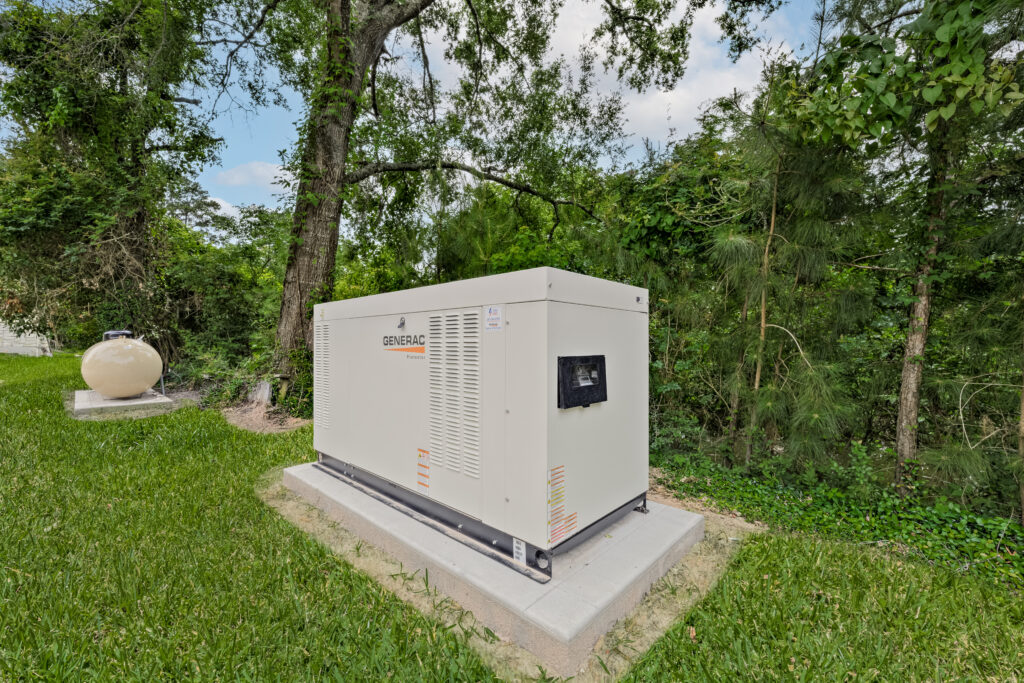
Short answer: a well-maintained air-cooled home standby generator commonly delivers 2,000 to 3,000 run hours, which for typical residential use often works out to 10 to 20 years. Liquid-cooled units are built heavier and generally last longer. Maintenance is the biggest variable — bigger than brand, bigger than model.
The honest answer depends far more on how a unit is cared for than on what badge is on the enclosure. But there are reasonable expectations worth knowing before you buy, and before you decide whether to fix one that is giving you trouble.
Years versus run hours
Standby generators wear by run hours, not calendar years. That is the thing most people miss, and it changes how you should read the number.
A generator that only runs its weekly self-test and a couple of outages a year accumulates hours very slowly. Two decades of that is a few hundred hours of actual running. The same unit somewhere with frequent multi-day outages might reach that in two hurricane seasons.
| Unit type | Typical run-hour expectation | Rough calendar equivalent |
|---|---|---|
| Air-cooled residential | 2,000–3,000 hours | Often 10–20 years |
| Liquid-cooled residential | Substantially higher | Often longer, with maintenance |
Treat those as ranges rather than promises. Manufacturer figures vary by model, and real-world results vary more than manufacturer figures do.
Estimating your own hours
Weekly self-tests at roughly 15 minutes each add up to about 13 hours a year. Add whatever outage hours you actually ran. Most controllers display total run hours directly, and that number tells you more about remaining life than the install date does.
What shortens it
Skipped maintenance. The largest factor by a wide margin. Oil loses its protective properties whether the engine ran or not. A clogged air filter makes the engine work harder every hour. A tired battery strains the starter. None of these fail dramatically; they accumulate.
Running undersized. A generator constantly asked to carry more than it comfortably should runs hot and works harder for every hour of its life. That is a sizing decision made once at install and then lived with for fifteen years. More on sizing.
Heat and restricted airflow. This matters more here than in most of the country. Gulf Coast summers are hard on engines, and a unit crowded by shrubs, fence, or piled debris runs hotter than one with clear airflow. Landscaping grows; clearances shrink.
Rodents and pests. More common than people expect in units that sit unused. A warm dry enclosure attracts rodents, wasps, and fire ants, and chewed wiring is a genuine failure cause.
Moisture and corrosion. Humidity here is relentless. Corroded battery terminals and connections cause failures that look mechanical but are not.
Fuel quality. Much less of an issue with natural gas and propane, which is one of the quiet advantages of both over gasoline. More on fuel choice.
What extends it
None of this is exotic:
- Annual service, or service by run hours, whichever comes first
- Honestly sized equipment rather than the cheapest unit that technically fits
- Clear airflow maintained over time, not just at install
- Battery replaced on schedule at three to five years rather than after it strands you
- Attention when the weekly self-test reports a fault
- A periodic load test, not just an oil change
Repair or replace? A practical framework
This is where the lifespan question usually comes from, so here is how we actually think about it.
Lean toward repair when
- The unit is in the first half of its expected run hours
- The failure is a discrete component — a battery, a controller board, a sensor
- It has been maintained reasonably
- Parts are readily available for the model
- It was correctly sized for the house to begin with
Lean toward replace when several of these are true
- The unit is well into its expected run hours
- It has failed more than once in a short window
- The repair cost is a significant fraction of a new install
- Parts are getting hard to source
- It was undersized from the start, so you would be repairing a unit that never really fit
- The failure is a major engine component rather than a bolt-on part
Putting a number on it
A new whole-house standby generator installed in this area typically runs $9,500 to $16,000 depending on size and site conditions. Full cost breakdown.
A useful rule of thumb: if a repair on an aging unit approaches roughly a third of replacement cost, price both before committing. Sometimes the repair still wins, because it buys five good years for a fraction of the money. Sometimes it is money spent on a unit that will need something else next season.
Signs a unit is nearing the end
None of these is fatal alone. Together they form a pattern:
- Harder starting, or needing multiple attempts to catch
- Repeat faults for different underlying causes
- Visible corrosion on the enclosure or internal components
- Noticeably increased oil consumption
- Intermittent self-test failures
- Rising vibration or new noises
- Parts becoming difficult to source
If you are seeing three or four of these, start budgeting rather than letting the failure pick its own timing.
Does the brand matter?
Less than maintenance, and less than sizing. A well-maintained unit from a reputable manufacturer will comfortably outlast a neglected premium one.
Where brand does matter is parts availability and local service depth over a fifteen-year horizon. A unit whose parts you cannot source in year twelve is effectively at end of life regardless of engine condition. More on brand comparison.
Frequently asked questions
How many years does a home standby generator last?
Commonly 10 to 20 years for air-cooled residential units with proper maintenance, though run hours matter more than years. Households with frequent long outages use that life up faster.
How many hours can a standby generator run continuously?
On natural gas, effectively as long as the outage lasts, with oil-consumption checks on very long runs. On propane, until the tank empties. Extended running accumulates hours quickly, so treat a multi-day outage as a service interval.
Does the weekly self-test wear the generator out?
No, and skipping it would be worse. Exercising the engine keeps seals and internals in better condition than letting it sit. The hours it adds are minor.
At what point is a generator not worth repairing?
When the repair approaches roughly a third of replacement cost on a unit already well into its run hours, particularly if it has failed more than once recently.
Can I extend the life of an older generator?
Yes, meaningfully. Catching up on maintenance, replacing a tired battery, clearing airflow, and correcting any undersizing all help. It will not undo accumulated wear, but it stops adding to it.
Do you service units you did not install?
Yes. We service Generac home standby generators regardless of who installed them, including units whose original installer is no longer in business. We do not work on diesel units or anything over 150 kW.
We will tell you straight
We install and repair these units, so we have no reason to push you either direction. If a repair buys you five good years, we will say so. If you are about to spend real money on a unit near the end of its life, we will say that too, and show you the numbers both ways.
Call 281-259-2182 · Generator repair · Montgomery, Waller, and Grimes counties and the greater Houston area