

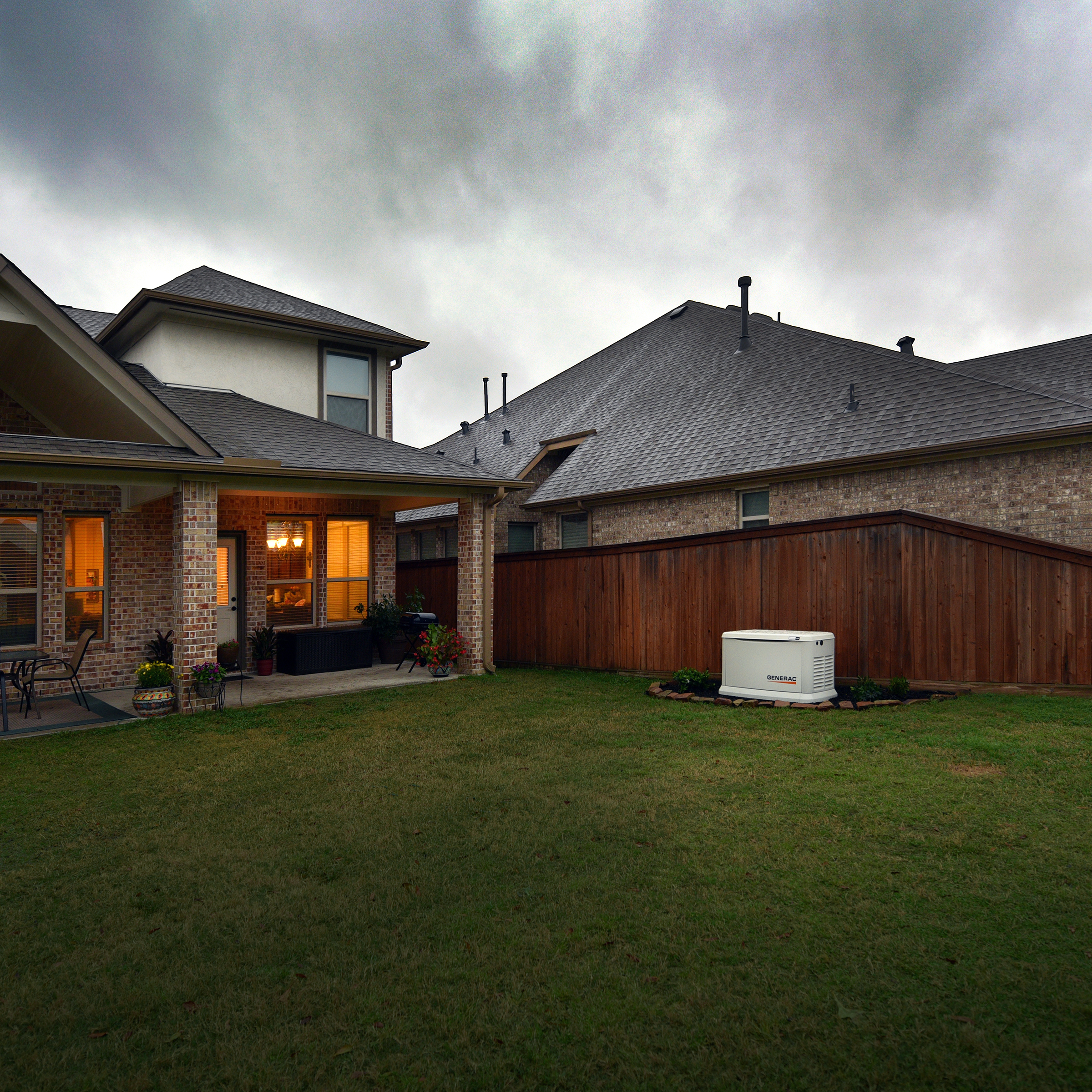
Generator sizing is where most homeowners get bad advice. Someone asks how many square feet your house is, names a kilowatt number, and moves on. Square footage is a starting point at best. What actually determines the size you need is your electrical load — specifically the biggest things that start up at once.
Here is how sizing really works, what a proper load calculation looks at, and how to tell whether a quote has sized your home correctly.
The quick version
For most Houston-area homes, the answer falls in one of three buckets:
- Essential circuits only: 10–14 kW. Refrigerator, lights, internet, a few outlets, one AC zone or a window unit.
- Whole home, one AC system: 18–22 kW. This covers the majority of suburban homes in our service area.
- Whole home, two AC systems or heavy loads: 24–36 kW or a liquid-cooled unit.
The 22 kW air-cooled unit is the most commonly installed size in the Houston market, and it is the right answer for a lot of homes — but not automatically for yours.
Sizing by home size and load
Use this as an orientation table, then confirm with a real load calculation.
| Home size | AC load | Recommended size | Coverage |
|---|---|---|---|
| Under 1,200 sq ft | 2–2.5 ton | 10–12 kW | Whole home or essentials plus AC |
| 1,200–1,800 sq ft | 3 ton | 14–18 kW | Whole home, single system |
| 1,800–2,600 sq ft | 4 ton | 20–22 kW | Whole home, most appliances |
| 2,600–3,500 sq ft | 5 ton or two systems | 22–26 kW | Whole home with load management |
| 3,500–4,500 sq ft | Two systems, pool | 26–36 kW | Whole home |
| 4,500+ sq ft | Multiple systems, shop, EV | 38 kW+ liquid-cooled | Whole home, sustained load |
Why air conditioning drives everything in Houston
In a colder climate, sizing conversations revolve around furnaces and well pumps. Here, it is air conditioning — and not the running load, the starting load.
An AC compressor draws several times its normal running current for the first fraction of a second it kicks on. A 4-ton unit that runs at roughly 4,000 watts can spike well past 10,000 watts on startup. Your generator has to absorb that surge without stalling or browning out everything else in the house.
This is why two homes with identical square footage need different generators. One with a single 4-ton system is straightforward. One with two 3-ton systems that could both call for cooling at the same moment is a harder problem, and the fix is either a bigger unit or smart load management.
What a real load calculation looks at
When we come out, we are not measuring your floors. We are cataloging:
- AC and heat — tonnage of every system, and whether you have electric strip heat or a gas furnace. Electric heat is a large add.
- Water heating — a tankless electric water heater can pull more than everything else in the house combined. Gas water heaters barely register.
- Well and septic pumps — common in Montgomery County and the outlying areas we serve. Pumps have hard starting loads.
- Pool equipment — pumps, heaters, and cleaners.
- Kitchen — electric range and oven, double ovens, cooktops.
- Laundry — electric dryers are a significant load.
- EV charging — a Level 2 charger can add 7–11 kW on its own. This is the fastest-growing reason homeowners outgrow the generator they installed five years ago.
- Medical equipment — oxygen concentrators, CPAP, home dialysis. These change the conversation from convenience to necessity.
- Your main panel — 100A, 150A, or 200A service, and how much headroom is left.
Whole-home coverage vs. managed loads
You have two ways to get there, and the cheaper one is not always obvious.
Size up the generator so it can run everything simultaneously, no restrictions. Simplest to live with, most expensive to buy.
Use load management — smart modules that briefly shed a large load when something bigger needs to start. In practice, your second AC compressor waits a few seconds while the first one comes up. You will not notice, and it can let a 22 kW unit cover a home that would otherwise need a 30 kW.
For a lot of homes, load management is the better value. It is worth asking any installer to price both approaches so you can compare.
The mistake of buying too small
An undersized generator is worse than none at all in one specific way: you find out during the outage. Symptoms include the unit tripping offline under load, lights dimming hard every time the AC starts, and the generator running at full tilt continuously, which shortens its life.
The tempting move is to accept a smaller unit to hit a budget. If that is where you are, the better path is usually a correctly sized generator covering fewer circuits — not an undersized one trying to cover everything.
The mistake of buying too big
Oversizing wastes money up front and runs the engine at very light load, which is not ideal for a generator either. It also means a bigger pad, potentially more gas supply, and higher maintenance costs. Right-sized beats generously sized.
One reasonable exception: if an EV, a pool, or a workshop is realistically in your next few years, size for that now. Adding capacity later means replacing the unit, not upgrading it.
Do not forget the gas supply
Sizing the generator is only half of it. A 22 kW unit needs real gas volume — roughly 200 to 300 cubic feet per hour at load. If your meter cannot deliver that while your furnace and water heater are also running, the generator will starve.
Any competent quote checks meter capacity as part of sizing. If a bid names a kW number without anyone having looked at your gas meter, it is incomplete. Once you know your size, our Houston generator cost guide shows what that configuration typically runs installed.
Frequently asked questions
What size generator do I need for a 2,000 square foot house?
Usually 20 to 22 kW for full whole-home coverage with a single 4-ton AC system. If you have electric heat, a tankless electric water heater, or an EV charger, expect to move up. If you only want essentials, 12 to 14 kW can be enough.
Will a 22 kW generator run my whole house?
For most homes up to about 3,000 square feet with one AC system, yes. With two AC systems it usually can, paired with load management. Homes with electric heat, multiple large loads, or EV charging often need more.
Can I run my air conditioner on a standby generator?
Yes, and in Houston that is the entire point. Central AC needs to be accounted for in the sizing, because of the startup surge. Any generator sized for a Houston home should be sized around the AC first.
How do I calculate my generator size myself?
Add up the running watts of everything you want powered, then add roughly 20% for startup surge and another 20% for future needs. It gets you in the neighborhood. It will not capture compressor inrush accurately, which is where DIY estimates most often come up short.
Does an EV charger change what size I need?
Significantly. A Level 2 charger adds 7 to 11 kW — comparable to a second AC system. If you have an EV or expect one, say so before anyone sizes your unit.
Is it better to oversize a little for future needs?
A modest amount of headroom is sensible, especially if a pool, addition, or EV is likely. Large oversizing costs more up front, runs the engine inefficiently, and does not buy reliability. One size class of margin is usually the right call.
Want this done properly? Request a free in-home assessment. We do the load calculation, verify your gas and panel capacity, and recommend a size based on your actual home — then show you what both the whole-home and load-managed options cost. You can also see how the installation process works start to finish.