

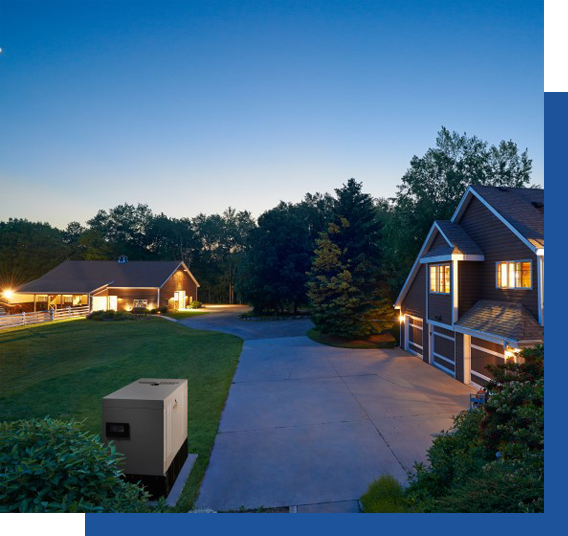
The power just went out, and the one piece of equipment you bought specifically for this moment is sitting there doing nothing. It is a bad feeling, and it happens more often than manufacturers like to advertise.
The good news: most no-start problems trace back to a short list of causes, and the most common one is cheap to fix. Here is how to work through it, what you can safely check yourself, and where the line is.
Before anything else: two safety rules
Do not open the generator enclosure while the unit is trying to start or in AUTO mode. It can crank without warning. Put the controller in OFF before you touch anything inside.
Do not run a portable generator anywhere enclosed. If you are pulling out a portable as a stopgap, keep it at least 20 feet from doors, windows, and vents, and never in a garage or breezeway even with the door open. Carbon monoxide from portable generators kills people after every major storm in this region.
Start here: read the controller
Your Generac control panel is telling you what is wrong. Open the small access door on the front of the enclosure and look at the display. You are looking for a red or yellow light and an alarm code.
Write the code down before you do anything else. If you clear it without noting it, you have thrown away the most useful piece of information a technician could have.
What the common Generac codes mean
| Code | What it means | Usual cause | Can you fix it? |
|---|---|---|---|
| 2750 | Low battery | Battery voltage sat below about 12.1V. Aged or failing battery, corroded terminals, or a dead trickle charger | Often yes |
| 1100 / 1101 | Overcrank — it tried to start and could not | Almost always fuel: closed valve, empty propane tank, low gas pressure. Sometimes plugs or air filter | Check fuel, then call |
| 1505 | RPM sensor loss while cranking | Fuel starvation or an ignition coil problem | Call |
| 1501 | RPM sensor loss after it was running | It stalled. Fuel supply, empty LP tank, coil failure, or a sudden overload | Call |
| 2100 | Overload | You asked it for more than it can deliver, or a circuit fault | Shed load, then call |
| 2800 / 2801 | Auxiliary shutdown | An external shutdown switch has been tripped. Only applies if your install has one | Sometimes |
| Low oil pressure | Safety shutoff engaged | Low oil, a leak, long runtime without a change, or a failed sensor | Check level, then call |
Code definitions vary between controller generations (Nexus, Evolution 1.0, Evolution 2.0). Confirm against your owner manual or Generac support if a code here does not match what you are seeing.
The five things to check, in order
1. The battery (start here, seriously)
A weak battery is the single most common reason a standby generator will not start. They typically last three to five years in Gulf Coast heat, sometimes less, and they usually fail without warning.
Look for corrosion on the terminals, a loose connection, or a swollen case. If you have a multimeter, a healthy resting battery reads around 12.6V. Much below 12.1V and it is the prime suspect. Note that a battery can hold enough charge to light up the controller and still not have enough amperage to turn the engine over.
2. Fuel supply
If your code points to overcrank, this is where to look. On natural gas, confirm the shutoff valve at the generator is open. Valves get bumped during landscaping and gas work more often than you would guess.
On propane, check the tank gauge. A 22 kW unit works through propane faster than most homeowners expect, and if the tank ran dry during a previous outage nobody may have noticed.
3. The controller switch position
Confirm the controller is set to AUTO, not OFF or MANUAL. This sounds too simple to mention. It is also a real service call we get several times a season, usually after someone did maintenance and forgot the last step.
4. Circuit breakers
Check the main line circuit breaker on the generator itself, and the breaker feeding the transfer switch. A tripped breaker can leave the unit running fine while delivering nothing to your house, which reads as a failure from inside.
5. Oil level
Pull the dipstick with the unit OFF. Low oil triggers a safety shutoff that will prevent starting, or let it start and then shut down seconds later. If oil is low, something used it or lost it, so topping off is a stopgap and not a repair.
The mistake that turns a small problem into a big one
Resetting the same fault over and over.
Clearing a code once to see whether it returns is reasonable. Clearing it five times is not. Repeated cranking drains the battery you may already be short on, and it can flood the engine, which turns a straightforward battery call into something considerably more expensive. If the same code comes back twice, stop and call.
What not to attempt yourself
We would rather tell you this plainly than have you find out the hard way:
- Gas line work. Leave pressure testing and any fitting work to a licensed plumber or gas tech.
- Anything inside the transfer switch. Live utility voltage. Licensed electricians only.
- Bypassing a safety shutoff. Low oil pressure and overspeed protection exist to stop the engine from destroying itself. Defeating them turns a repair into a replacement.
- Valve adjustment, coils, or the fuel regulator. These need proper tools and specs.
Why this happens during outages specifically
Standby generators sit idle for months. The weekly self-test runs the engine for a few minutes with no load on it, which confirms it starts but proves nothing about whether it can carry your house. Batteries weaken quietly. Rodents nest in enclosures. Fuel systems develop small problems that only show up under real demand.
This is the entire argument for annual service. A unit that gets checked every spring has a dramatically better chance of running when a storm arrives than one nobody has touched since installation. Our Houston generator maintenance and service page covers what a visit includes.
Also worth checking: if your remote monitoring runs over home Wi-Fi, it went dark the moment you lost power. LTE-based monitoring keeps reporting during the outage, which is when a failed self-test actually matters.
When to call us instead of troubleshooting
Call right away if you see any of these:
- The same fault code returns after one reset
- You smell gas anywhere near the unit — move away from it and call your gas utility first
- It starts and then shuts down within seconds
- Any RPM sensor loss code
- Grinding, knocking, or smoke
- Someone in the house depends on medical equipment
Fair warning about timing: during a regional outage every generator owner in the area calls at once. Service gets triaged and wait times stretch. That is not an excuse, it is the reality of the business, and it is the strongest practical case for getting your unit serviced before the season rather than during it.
Frequently asked questions
Why won’t my Generac generator start during a power outage?
The most common cause by a wide margin is a weak or dead battery, which typically shows as code 2750. After that: a fuel supply problem such as a closed valve or empty propane tank (usually an overcrank code, 1100 or 1101), the controller left in OFF instead of AUTO, a tripped breaker, or low oil triggering a safety shutoff. Read the code on the controller before doing anything else.
How do I reset a Generac generator fault code?
Navigate to the fault on the control panel, press Enter to acknowledge it, then use the controller menu to clear it. If the underlying condition is resolved, the unit returns to AUTO. Some codes require dealer-level access to clear. Reset once to see whether the fault returns, and if it does, stop resetting and get it diagnosed.
How long does a standby generator battery last?
Three to five years in the Houston climate, sometimes less. Heat is hard on batteries. Replacing one proactively at the three-year mark costs far less than an emergency call during an outage, and it is the cheapest reliability improvement available to you.
My generator starts then shuts off after a few seconds. What is wrong?
That pattern usually points to a safety shutoff doing its job, most often low oil pressure, or to fuel starvation where the engine fires on residual fuel then stalls. Check the oil level with the unit OFF. If oil is fine, stop cranking it and call, because repeated attempts can flood the engine.
Can I check anything myself, or do I need a technician?
You can safely read the fault code, inspect battery terminals for corrosion, confirm the fuel shutoff valve is open, check the propane tank level, verify the controller is in AUTO, look at the breakers, and check the oil level with the unit OFF. Everything past that — gas lines, the transfer switch, ignition components, safety circuits — needs a licensed tech.
Does the weekly self-test mean my generator will work in an outage?
Not reliably. The self-test runs unloaded, so it confirms the engine starts and nothing more. It cannot tell you whether the unit can carry your air conditioning and your whole panel. That takes a load test during annual service, which is why a passing self-test history and an actual no-start are not contradictory.
Generator down right now? Get in touch and we will get you into the schedule. If it is running but you are past due on service, book maintenance before the next storm. And if you are reading this because you do not have backup power yet, our Houston generator cost guide and sizing guide are the place to start.