

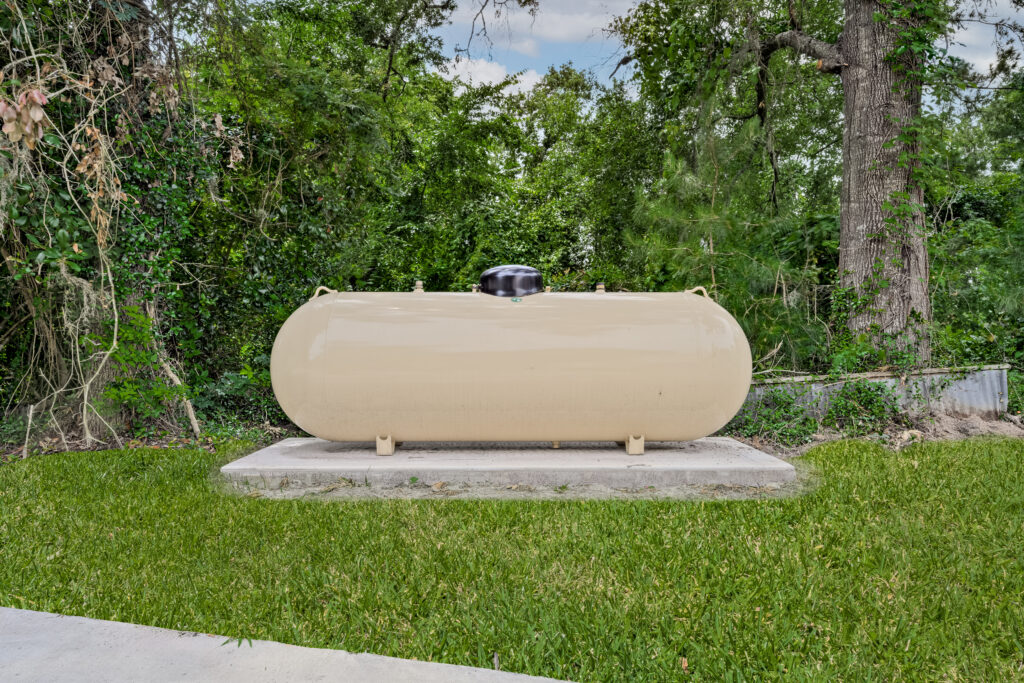
Short answer: if you have a natural gas line with adequate capacity, use it — unlimited runtime with nothing to refill. If you do not have a gas line, propane is a perfectly good answer and it is what a large share of rural and semi-rural installs run on. The decision is usually made by what is available at your property, not by fuel cost.
Out in the parts of Montgomery, Waller, and Grimes counties we serve, plenty of homes have no natural gas line at all. If that is you, this decision is already largely made — but it is worth understanding what you are getting either way.
Side by side
| Natural gas | Propane | |
|---|---|---|
| Runtime | Effectively unlimited | Limited by tank size |
| Refueling during an outage | None needed | Delivery, if available |
| Requires utility line | Yes | No |
| Storage life | N/A | Indefinite, does not degrade |
| Typical running cost | Generally lower | Generally higher |
| Availability in rural areas | Often unavailable | Widely available |
| Upfront cost | Gas line work if needed | Tank purchase or lease |
| Energy per unit volume | Lower | Higher |
Natural gas
The case for it. Effectively unlimited runtime. Your generator draws from the utility supply, so it can run for days without anyone refueling anything. No tank to monitor, no delivery to schedule, nothing to run out of at 2 a.m. on day three.
For a multi-day hurricane outage, that is a meaningful advantage, and it is the main reason we recommend natural gas whenever the line exists.
The catch. You need a gas line that reaches the property with adequate capacity, and it has to be able to serve the generator alongside whatever else is drawing on it. A line sized for a furnace and a water heater may not comfortably supply a large generator at full load, and that gets assessed before install rather than discovered after.
If the line does not currently reach where the generator will sit, running it is a real cost that belongs in the quote.
Natural gas supply can also be interrupted in a severe event. It is rare, and rarer than electrical outages, but it is not impossible.
Propane
The case for it. It works anywhere. No utility line required, which is why it is the default for rural and semi-rural properties across this region.
Propane also stores indefinitely without degrading. Gasoline goes stale in months and diesel has its own storage issues, but propane sitting in a tank for two years is still perfectly good fuel. For something that might not be needed for a year at a time, that matters.
It also burns cleanly, which is a little easier on the engine over a long life.
The catch. Finite runtime. When the tank empties, the generator stops. Tank size and refill logistics become part of your outage plan rather than an afterthought, and during a widespread event propane delivery demand spikes exactly when you need it.
How long will a propane tank actually last?
This is the question that decides tank size, and the honest answer is that it depends on three things.
Tank size. A 250-gallon tank and a 500-gallon tank represent very different outage plans. Worth noting: propane tanks are filled to roughly 80% capacity for safety, so a 500-gallon tank holds about 400 usable gallons. Factor that into any math you do.
Load. This is the big variable. Running the whole house including central air uses dramatically more fuel than running essentials only. The same tank might last two days or five depending entirely on what is switched on.
Generator size and how hard it is working. A larger unit under light load is more efficient than people assume. A larger unit under full load burns accordingly.
If you are on propane and want a specific runtime target — say, “I want to survive four days without a delivery” — tell your installer that. It is a legitimate input into both tank sizing and generator sizing, and it is much cheaper to get right at install than to fix later.
Which is cheaper to run?
Natural gas is generally cheaper per unit of energy where it is available.
But this usually matters less than people expect, because a standby generator runs a handful of hours a year in a normal year. Thirteen hours of weekly self-tests plus whatever outages occur is not a large fuel bill either way. Availability and runtime decide this, not the per-unit price.
The exception is a household with frequent long outages, where running hours climb into the hundreds. There the fuel cost difference starts to show up.
Can a generator run on either?
Many standby units are dual-fuel capable and get configured for natural gas or propane at installation. The two fuels have different energy densities, so the unit is set up for one or the other.
Conversion later is possible but it is work, and on some units it affects the power output rating. If there is any chance a gas line is coming to your property in the next few years, mention it before install rather than after.
What about the generator output?
Worth knowing: the same generator often produces slightly different rated output on natural gas versus propane, because of the energy density difference. Propane typically yields a bit more.
It is usually a small difference, but on a unit sized right at the edge of your load it can matter. Another reason sizing and fuel choice should be one conversation rather than two. More on sizing.
Frequently asked questions
Which is better for a standby generator, propane or natural gas?
Natural gas if you have an adequate line, because runtime is unlimited. Propane if you do not, and it is a perfectly good option rather than a compromise.
How long will a 500-gallon propane tank run a generator?
It depends on load and generator size. A 500-gallon tank holds roughly 400 usable gallons. Ask your installer to estimate against your specific unit and the loads you plan to run.
Does propane go bad in storage?
No. Propane stores indefinitely without degrading, which is a genuine advantage over gasoline or diesel for fuel that sits unused.
Can I switch from propane to natural gas later?
Often yes, but it is a conversion job rather than a switch, and on some units it changes the output rating. Plan for it at install if a gas line is a realistic future possibility.
Do I need a bigger propane tank for a generator?
Frequently, yes. A tank sized for a stove and water heater will not carry a whole-house generator through a multi-day outage. This gets assessed as part of the install.
Will natural gas keep flowing during a hurricane?
Usually. Gas distribution is underground and generally more resilient than overhead power lines, though interruptions are possible in severe events.
We will look at what you have
We will assess what is actually available at your property, what you want running, and how long you want to be able to run it, then tell you which fuel makes sense. If a gas line is not realistic, propane is a good answer and we will size the tank properly rather than leaving it to chance.
What a whole-house generator costs · What size you need
Call 281-259-2182 · Montgomery, Waller, and Grimes counties and the greater Houston area